



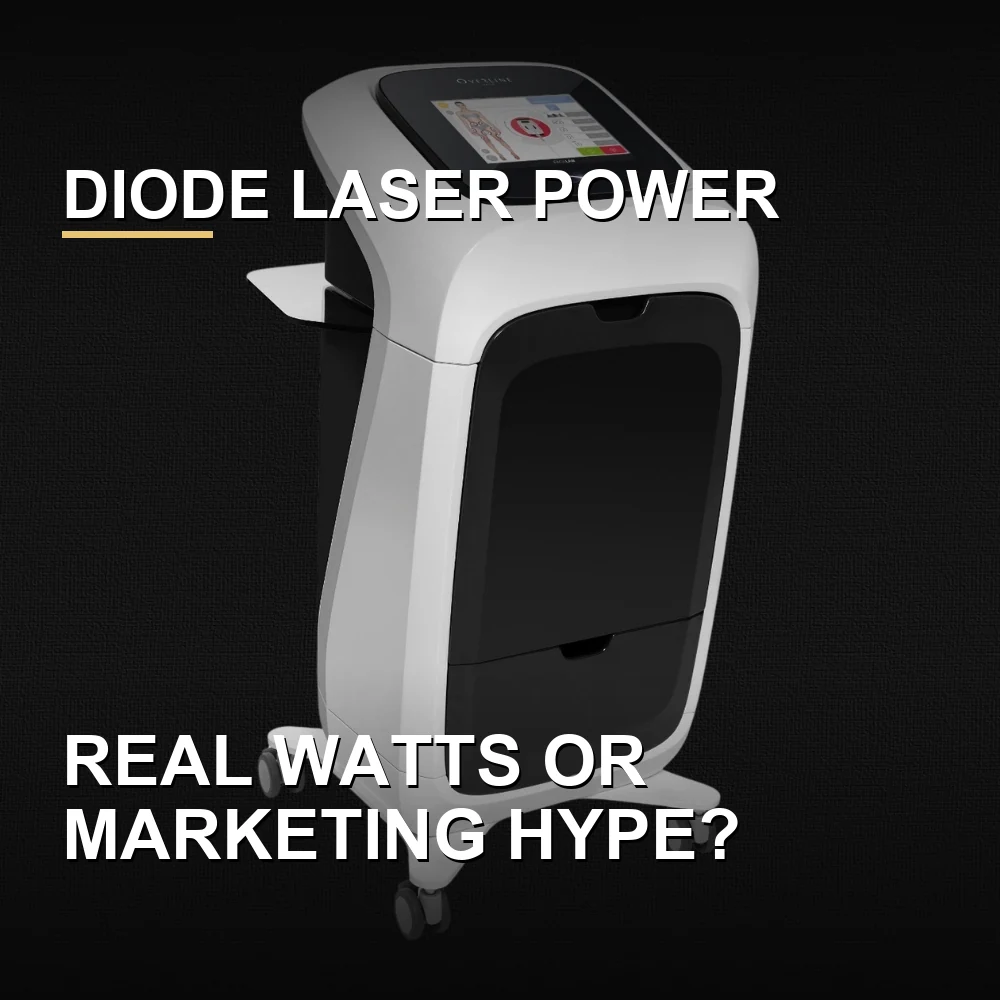
In short: the real power of a diode laser is not the “W” number printed on the housing. That figure is usually peak power, not what the machine delivers in daily work. True diode laser power depends on three things together: the mode (peak or average), the number of diode bars, and, above all, the power supply. And it is confirmed by measurement, not by a sticker.
- “3000 W” is peak power, not real work
- Why peak power cannot be held continuously
- The power supply sets the true ceiling
- One “W” number means nothing without three details
- How to check the real diode laser power
- Watts vs fluence: do not confuse them
“3000 W” is peak power, not real work
A diode stack can be driven in two ways. In continuous mode (CW) a typical 808 nm bar sustains, roughly, 100 W. Pulsed in short bursts at low duty cycle (QCW), the same class of bar is rated several times higher, around 300 W peak. That is roughly a threefold difference for the same class of bar, and in general the peak figure runs 3 to 5 times higher than the average.
In advertising, manufacturers quote the peak number: it is bigger and sells better. But the machine does not work at peak, it works at average power. So “3000 W” on the housing and the real working power are two different numbers.
| Mode | Power per diode bar | Can it run continuously? | What it means |
|---|---|---|---|
| Continuous (CW) | about 100 W | Yes | Real, sustained working power |
| Pulsed peak (QCW) | around 300 W, in bursts | No, short bursts only | The big marketing number |
Why peak power cannot be held continuously
Real diode laser power is always the sustained average, never the peak. A diode is limited by heat. At high power the crystal heats up, and beyond a certain point irreversible facet damage occurs (COD, catastrophic optical damage). This is exactly why manufacturers deliberately cap the power and duty cycle: a high peak is possible only in short pulses, and no machine can sustain it continuously. The peak figure physically cannot be the working figure.
The power supply sets the true ceiling of diode laser power
This is the main thing the advertising stays quiet about, and that even some equipment sellers do not understand. All bars in a stack are connected in series, and the optical power of a diode is set by the pump current, not by what is written on the housing. Roughly, a stack of 12 bars at 100 W each needs about 100 A at around 20 V.
So the true ceiling of diode laser power is set not by the stack but by the power supply: the machine cannot output more than the supply can physically deliver. Real power is always the combination of stack plus driver plus power supply, not a single label. (Sources: RP Photonics: Diode Stacks, RP Photonics: Laser Diode Drivers.)
One “W” number means nothing without three details
Before you trust any wattage, ask three questions:
- Is it peak or average power? The difference is several times over.
- How many bars are in the stack? Total power equals the number of bars times the power of one bar.
- What mode and driver current? The same “2000 W” can describe two completely different machines.
How to check the real diode laser power
- Measure it. Real output is measured with a power or energy meter (an integrating sphere gives the full optical power regardless of beam shape). Over time the real power of a machine gradually drops and rarely matches the datasheet exactly, so it is worth checking periodically with an instrument.
- Ask for the configuration: number of bars, mode (CW or QCW), driver current, and the power supply rating.
- Cross-check: whether the power supply can physically deliver the stated stack power. (Sources: Tektronix, Gentec-EO.)
Watts vs fluence: do not confuse them
These are two different characteristics that are easy to mix up.
- Fluence (J/cm2): how much energy reaches the skin. This is what destroys the follicle. The working value is roughly 20 to 40 J/cm2, set by the operator for the skin and hair type.
- Power (W): not about “will it work”, but about productivity: how large a spot the machine holds and how fast it treats.
Put simply: fluence decides the result on the follicle, power decides the speed and the spot size. A big diode laser power figure on the sticker does not automatically mean a better result.
Buying a diode laser and want honest numbers?
At Laser Technology we build our own EOS and Hunter diode lasers, and we state real working power, not peak marketing watts. Leave your details and we will match a machine to your client flow, with warranty and operator training.
Frequently asked questions
How many watts does a diode laser really have?
Why does the housing say 3000 W?
How do I check real diode laser power?
Do more watts mean better hair removal?
Updated: 13 July 2026