



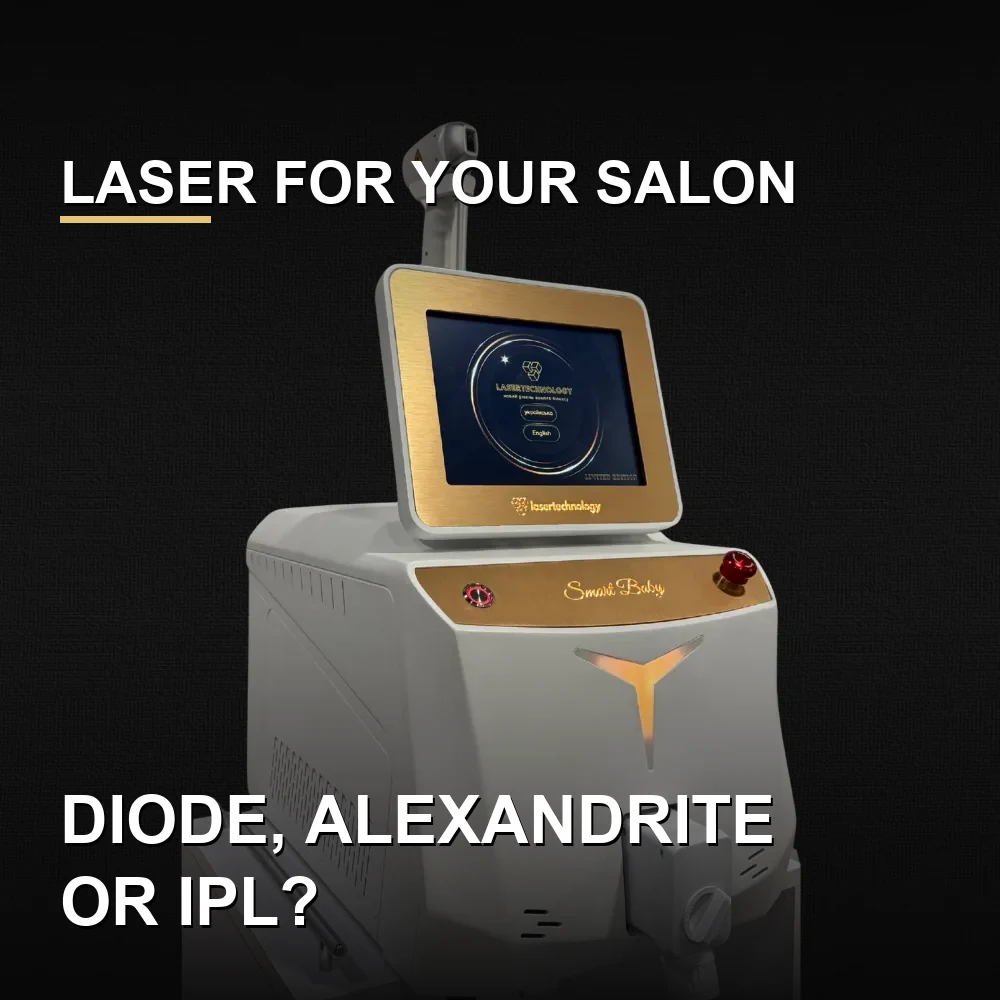
When a salon or clinic picks a hair removal machine, the real question is not only “which model”, but “which technology”. There are four main types on the market: the diode laser, the alexandrite, the Nd:YAG and IPL. Each works at its own wavelength and suits its own skin and hair type. So the first thing to decide when choosing a laser hair removal machine for your salon is the technology that fits your audience and client flow.
The short answer for most salons: the workhorse is an 808 nm diode laser. It is versatile across skin types, handles coarse hair, and holds up under a busy schedule. Alexandrite (755 nm) is faster on light skin with fine hair, but risky on tanned skin. Nd:YAG (1064 nm) is the safest on dark skin, but slower and more painful. IPL is not a laser at all: cheaper to buy, but weaker and needing more sessions. Below we break down each type with numbers, pros and cons.
Laser Technology has serviced diode lasers from many brands for over 8 years. We are not resellers: hundreds of machines have passed through our workshop, so we see what actually works in a busy salon and what only looks good in an advert and comes back for repair. This article is an honest guide to choosing the technology, without “our machine is the best”.
Contents
- Comparison table: how laser types for hair removal differ
- How a hair removal laser works and what fluence is
- How does a diode laser differ from alexandrite?
- Diode laser or IPL: what is the difference?
- Is “3 wavelengths in one machine” really better?
- Which laser handles dark skin and tan?
- Does a laser remove grey and light hair?
- What extra functions exist besides hair removal
- What to look for in a laser hair removal machine for your salon
- Which models we recommend
- What a salon should choose in the end
Comparison table: how laser types for hair removal differ
| Machine type | Wavelength | Best for skin type | Strength | Weakness | Role in the salon |
|---|---|---|---|---|---|
| Diode | 808 nm | I-VI (all-rounder) | Balance of absorption and depth, handles coarse hair, holds a busy flow | Not the peak choice on very fine, light vellus hair | The base for most salons |
| Alexandrite | 755 nm | I-III, light skin | Fast, good on fine and light hair | Risk of burns and pigmentation on tanned and dark skin | Salons with a light-skinned audience |
| Nd:YAG | 1064 nm | IV-VI, dark skin | Safest for dark skin and tan, deep penetration | Slower, more painful, more expensive | Dark skin, working with tan |
| IPL (not a laser) | Broad light spectrum | I-III | Cheaper entry, can do photorejuvenation | Scattered energy, more sessions, weaker on coarse hair | Budget start or add-on, not main hair removal |
| Ruby (legacy) | 694 nm | I-II only | Historically the first hair removal laser | Very slow, unsafe on darker skin, effectively obsolete | No longer used in practice |
How a hair removal laser works and what fluence is
Every hair removal laser works on the same principle. The beam is absorbed by melanin (pigment) in the hair, heats the follicle to roughly 70-75 °C and destroys the growth zone. The follicle sits 3-7 mm deep, so the wavelength has to reach exactly that far.
Two different characteristics are at work here, and they are easy to confuse. Fluence (energy density, J/cm²) is what acts on the follicle: for a stable result you need roughly 20 to 40 J/cm², set by the operator. Stack power (watts) decides something else: the size of the working spot and the speed of treatment. The same fluence can come from a weaker or a stronger machine, so a big wattage number on the housing does not by itself guarantee a result. On top of that, advertised watts are often peak, not real: we cover this in detail in Diode Laser Power: How Not to Fall for Inflated Watts.
How does a diode laser differ from alexandrite?
This is the most common comparison, because both work at close wavelengths. The difference is in the balance between melanin absorption and penetration depth.
Alexandrite 755 nm is strongly absorbed by melanin and stays shallow. That makes it fast and good at fine, light hair on light skin (types I-III). The flip side: on tanned or dark skin that same strong reaction to melanin brings a risk of burns and pigmentation.
Diode 808 nm is the workhorse of hair removal: absorption is a little weaker, but penetration is deeper, so it is more universal across skin types and confidently handles coarse hair. In our own side-by-side testing on identical areas, the diode laser reached 88.8% effectiveness against 77.7% for alexandrite.
The conclusion is simple. Alexandrite makes sense if your audience is mostly light-skinned. For a mixed audience, with tan and different skin types, the diode is more universal and safer in daily work.
Diode laser or IPL: what is the difference?
IPL is not a laser. A laser gives one precise wavelength, while IPL is a broadband flash of light that scatters energy across a whole spectrum. Because of that, the energy density on a single hair is lower, and the result on coarse and dark hair is weaker. In practice this means more sessions and a less consistent result under a busy flow.
The upside of IPL: it is cheaper to buy and can do photorejuvenation. So as an add-on procedure it has its place. But as the main hair removal machine in a salon, where speed and a repeatable result matter, the diode laser is stronger.
One more point that often gets confused. Modern diode lasers work in SHR mode (gradual heating with a moving handpiece), not only in the old HR mode (single powerful pulses). In our own testing on the underarm area (92 participants), SHR mode gave 90.2% effectiveness against 87% for HR, with less pain. IPL has no such mode.
Is “3 wavelengths in one machine” really better?
Here you have to separate two different things.
Separate lasers with different wavelengths is normal and even correct: each wavelength really does work better for its skin type (755 for light skin and fine hair, 808 all-rounder, 1064 for dark skin). If a salon has the budget for several machines, that is a strong setup.
But “3 wavelengths, 755/808/1064, in one diode stack” advertised for a single machine is another story. Look at how the power is split. If a stack of, say, 1000 W is divided across three wavelengths, you get roughly 600/200/200 W, and none of the three runs at full power. You end up with three weak wavelengths instead of one strong one.
That is why 808 nm in our own line is not a compromise or a way to cut costs. It is a deliberate engineering choice: one universal working wavelength running at full power, instead of three divided ones. One strong 808 beats three weak beams in one housing.
Which laser handles dark skin and tan?
The safest for dark skin (types IV-VI) and for working with a tan is Nd:YAG 1064 nm. It is absorbed less by the melanin in the skin itself and goes deeper, so there is less risk of a burn. Diode 808 nm also works on dark skin with the right settings and good cooling, but more carefully. Alexandrite 755 nm on dark and tanned skin is the biggest risk.
If clients with dark skin or a tan come to you often, look toward machines with a 1064 nm wavelength. In our line that is the Overline Infinity Extreme (808+1064 nm, two separate sources, each for its own skin type).
Does a laser remove grey and light hair?
The honest answer: poorly, and this is not a flaw of a particular machine, it is physics. Any hair removal laser works on melanin (hair pigment). Grey, very light and reddish vellus hair has almost no melanin, so the laser “does not see” it, regardless of the type or price of the machine. If a seller promises their laser “removes everything, even grey”, that is a reason to be cautious.
What actually removes such hair: electrolysis. It works with current on each hair individually and does not depend on pigment. So salons that want to serve a client 100% run the laser as the main service plus electrolysis for light, grey and vellus hair.
What extra functions exist besides hair removal
Some diode laser models can do more than hair removal, for example skin rejuvenation (photorejuvenation of the face, neck and décolletage). For a salon this is a separate service and a higher average ticket from the same machine: the client comes for hair removal, and you also offer rejuvenation. This function is available on some models in our line, so if it interests you, ask about the specific machine during a consultation.
What to look for in a laser hair removal machine for your salon
Wavelength is only the first step. Once the technology is settled, you look at the hardware:
- Real power, not “fake watts” on a sticker. A claimed 2000 W means nothing if the power supply physically cannot deliver that energy. Ask about the real fluence (J/cm²) and the maker of the diode stack (Focuslight, Coherent, Jenoptik versus an unnamed no-name).
- Cooling. For a busy flow you need a liquid chiller, a system that cools the diode stack with water. Without it, after 4-5 clients in a row the stack overheats, power drops and the machine can throw an error in the middle of a shift.
- Working spot size. A larger spot means faster treatment of large areas (legs, back); a smaller one is needed for the face and bikini.
- Service and warranty in your region. We provide our own warranty, operator training and a technician with spare parts on hand, so a machine that goes down does not stop your schedule for weeks.
Which models we recommend
Whatever the technology, here are three machines from our line for different salon tasks. The range is large, this is only a guide; we will match the exact model to your budget.
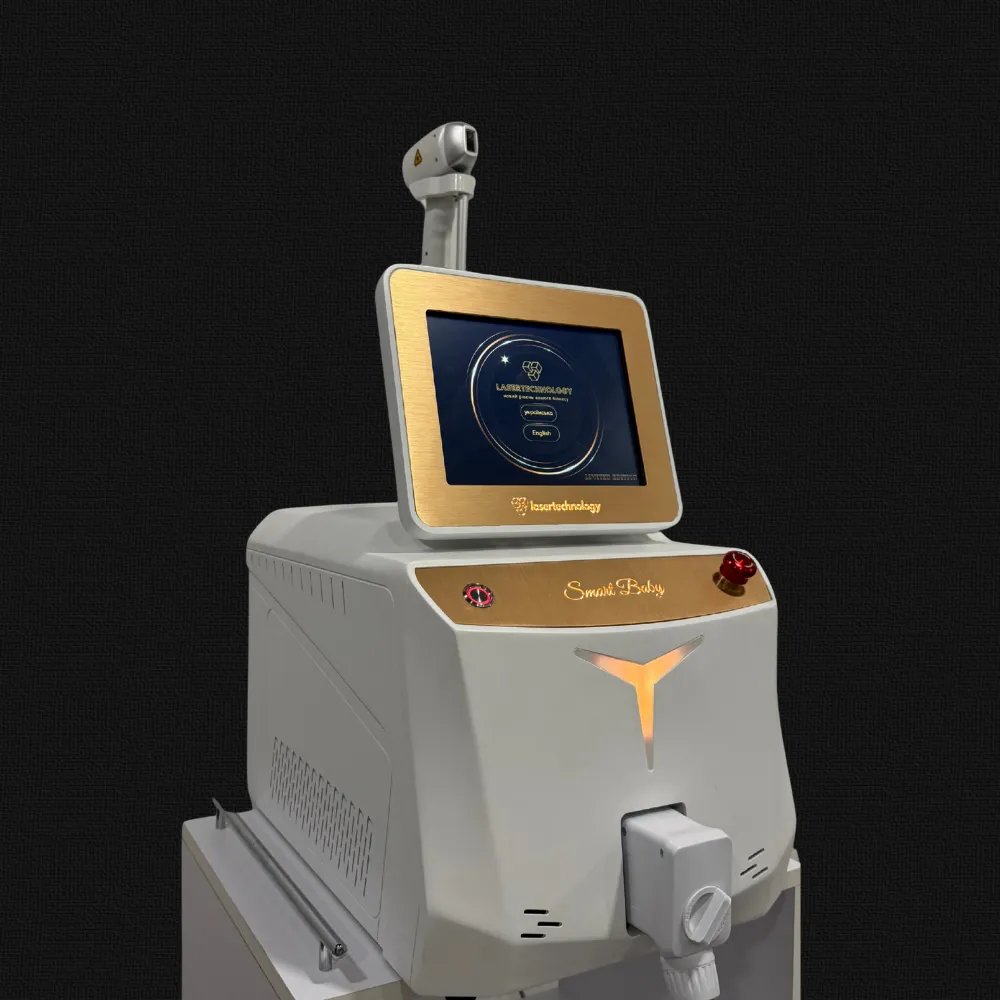
Smart Baby 1200
Powerful portable, 808 nm. For mobile work and cabinets with a steady flow. €13,700
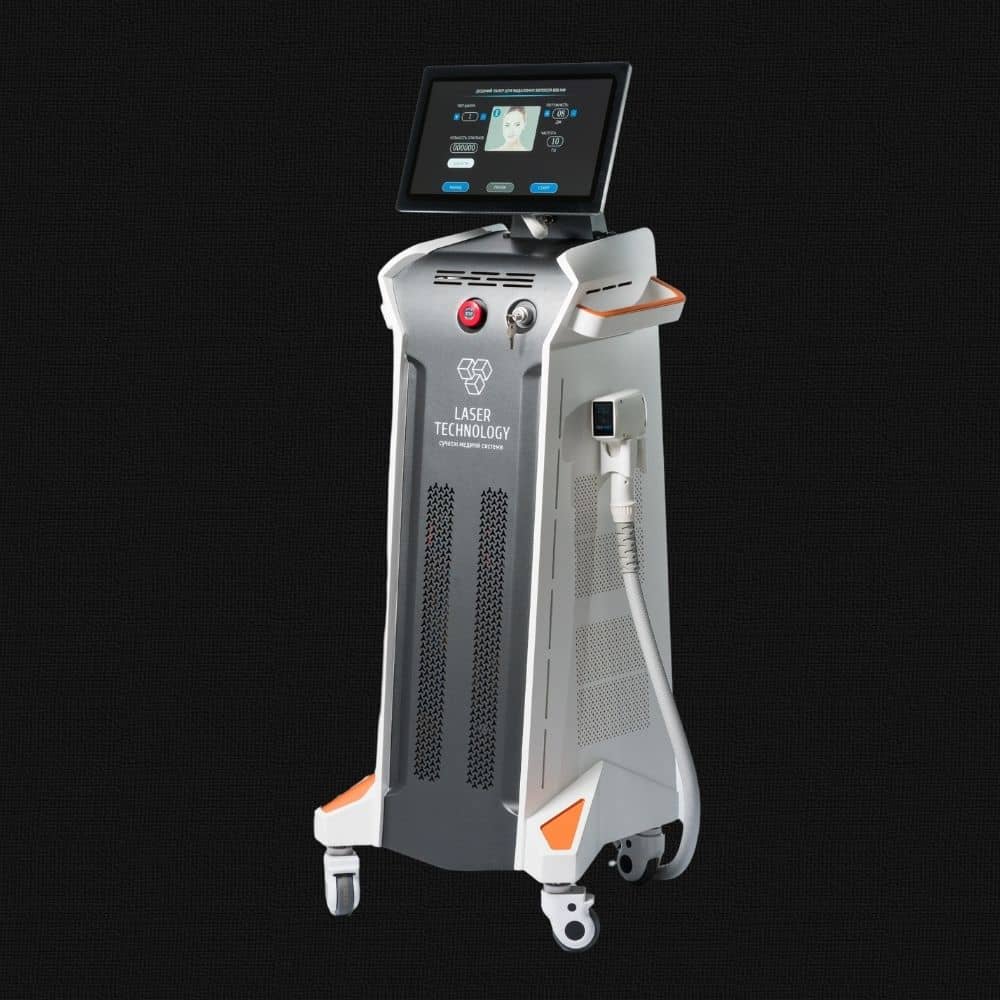
Hunter 2000
Stationary flagship, 2000 W, chiller. For salons with a high client flow. €21,200
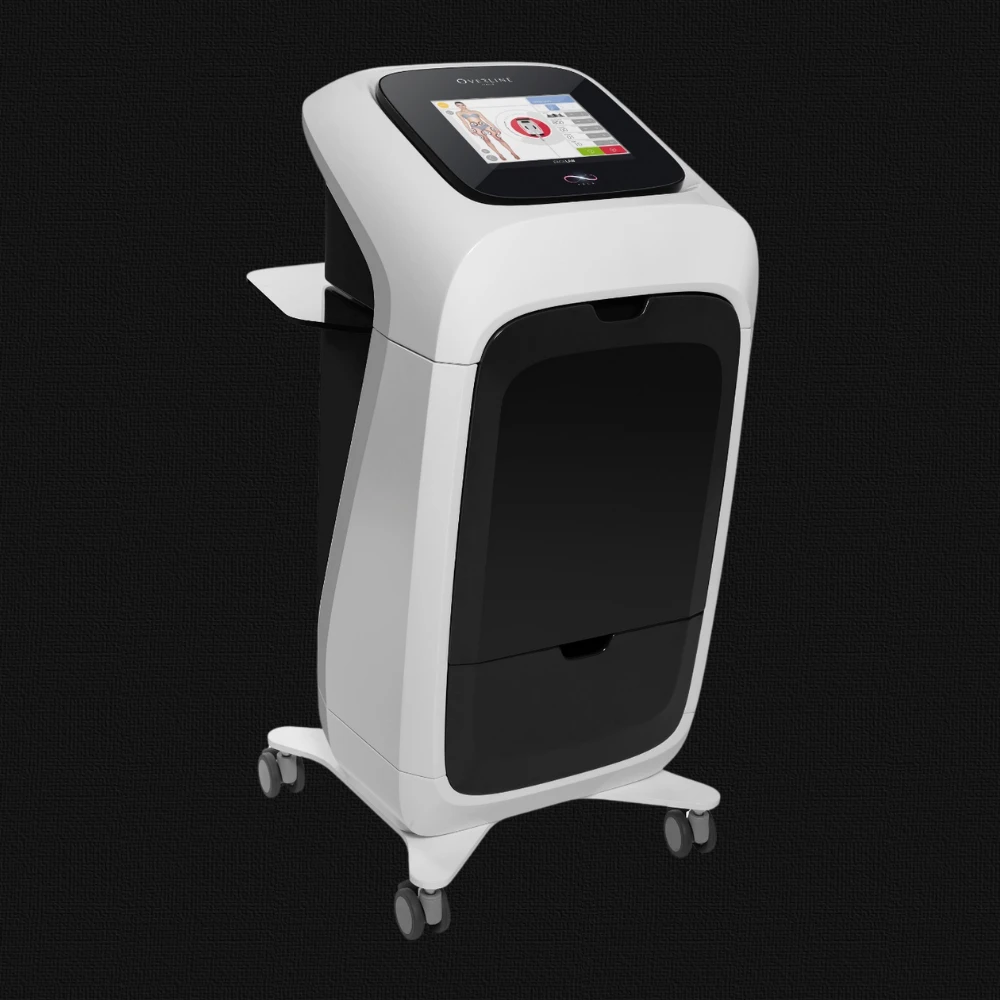
You can see all models with prices in the diode laser catalogue.
What a salon should choose in the end
To bring it all together, which laser hair removal machine to choose for different situations:
- Diode 808 nm is the base for most salons with a mixed audience. Universal, safe in daily work, holds a busy flow.
- Alexandrite 755 nm makes sense if your clients are mostly light-skinned with fine hair.
- Nd:YAG 1064 nm (or a diode with an added 1064 wavelength, like the Overline) for an audience with dark skin and tan.
- IPL as an add-on service or a budget start, but not as the main hair removal machine under a busy flow.
If you want to work through your case for a specific audience and flow, we offer a free consultation and an equipment test-drive. Tell us about your audience and how you work, and an engineer will suggest the technology and the model. No pressure and no promises of easy money.
Choosing a laser for your salon?
Tell us about your audience and client flow, and an engineer will suggest the technology and the model. The consultation is free and commits you to nothing.
Frequently asked questions
Which laser hair removal machine is best for a salon?
Diode or alexandrite laser: which to choose?
Can one diode laser work with all clients?
Diode or IPL: which is more effective?
Is it true that more wavelengths mean a better machine?
Which laser is safe for dark skin and tan?
Does a laser remove grey and light hair?
Updated: 13 July 2026